
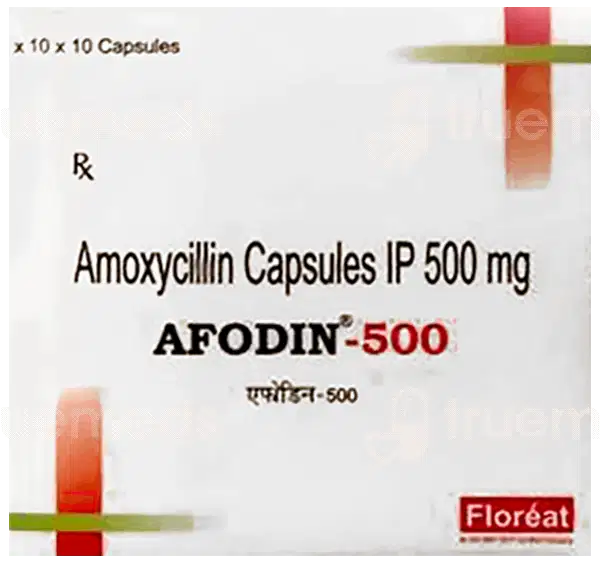
Afodin 500 MG Capsule 10
₹59.34
Quick fact
Afodin is an amoxicillin capsule used for bacterial infections, including infections of the throat, ear, respiratory tract, urinary tract, skin and soft tissues.
Uses
What is Afodin 500 MG Capsule 10 & Important Details
Afodin is an antibiotic used to treat certain infections caused by bacteria. The infection being treated and the prescribed course determine how it should be taken.
- It is supplied as a capsule in a pack of 10 capsules.
- The active ingredient is amoxicillin.
- Listed uses include bacterial infections of the throat, ear, sinuses, respiratory tract, urinary tract, skin and soft tissues, and typhoid fever.
How does Afodin 500 MG Capsule 10 work (mechanism of action)?
Amoxicillin acts against bacteria by preventing them from forming a cell wall they need to survive.
- It prevents formation of the bacterial cell wall.
- Without that wall, bacteria cannot survive.
Specialized or Off-Label Uses of Afodin 500 MG Capsule 10
The available information describes treatment of bacterial infections and H. pylori in people with peptic ulcer disease. Other specialized or off-label uses are not established here.
Conditions That Afodin 500 MG Capsule 10 Will Not Treat
Afodin does not treat viral illnesses such as the common cold or flu. It is an antibiotic for bacterial infections.
Benefits
What are the benefits of taking Afodin 500 MG Capsule 10
When prescribed for an infection caused by susceptible bacteria, Afodin can help stop bacterial growth. Completing the prescribed course helps ensure the bacteria are killed.
- It is used for a range of bacterial infections, including some respiratory, urinary, skin and soft-tissue infections.
- It may help eliminate H. pylori in people with peptic ulcer disease.
Side Effects
What are the most common side effects of Afodin 500 MG Capsule 10?
Nausea and diarrhoea are identified as common side effects. They may settle, but seek medical advice if they persist or you are worried.
- Nausea
- Diarrhoea
Contact your doctor if these effects continue or your condition worsens.
What are the serious side effects of Afodin 500 MG Capsule 10?
Stop taking Afodin and contact a doctor immediately if you develop symptoms that may indicate a serious reaction.
- An itchy rash
- Swelling of the face, throat or tongue
- Difficulty breathing
These symptoms need immediate medical attention. Do not take another dose while seeking help.
Severe Allergic Reactions of Afodin 500 MG Capsule 10?
A severe allergic reaction may cause symptoms that need urgent attention.
- Itchy rash
- Swelling of the face, throat or tongue
- Breathing difficulties
Stop the medicine and seek emergency medical care if these symptoms occur.
What side effects may I notice from receiving this medication?
Some people may notice side effects while taking Afodin.
- Nausea or diarrhoea
- Rash or vomiting
The frequency of rash and vomiting is not specified. Ask a doctor if a side effect persists or concerns you.
Afodin 500 MG Capsule 10 Dosage Guidelines
Overview
The dose and treatment duration depend on the infection and must be set by a doctor. A general adult reference dose for this capsule is 500 mg every 8 hours; the doctor decides the final dose.
Adults
The dose is decided by your doctor according to the infection being treated and your health. Ask your doctor or pharmacist for the exact amount and schedule; the doctor may change it.
Children
A standard child dose for Afodin is not established in the available information. Do not give it to a child unless a doctor advises it; a doctor must decide the dose.
Older adults
A usual older-adult dose is not established in the available information. Ask a doctor to choose the lowest effective dose for your needs; the doctor decides.
- The type and severity of infection affect the prescribed dose and course.
- Kidney problems may require caution and medical advice.
Dosage Adjustments for Kidney, Liver, or Other Health Problems
Dose changes depend on health conditions and kidney function. Ask the prescriber or pharmacist to confirm the right schedule.
- Normal kidney function: Follow the dose prescribed for the infection.
- Reduced kidney function: Use with caution and ask a doctor about the dose.
- Severe kidney impairment: A lower dose or longer interval may be needed; the exact adjustment is not established in the available information.
- Dialysis: A dialysis-specific schedule is not established in the available information. Ask the treating doctor.
- Liver disease: A dose adjustment for liver disease is not established in the available information.
- Other important conditions: Tell the doctor about trouble urinating and any other health conditions before treatment.
Do not change the dose yourself; get medical advice for an individual adjustment.
How Often and How Long to Take Afodin 500 MG Capsule 10?
Take Afodin at the intervals and for the duration prescribed. The doctor determines the exact schedule based on the infection.
- Take doses at evenly spaced intervals as prescribed.
- Do not skip doses, and complete the prescribed course.
How should I take Afodin 500 MG Capsule 10?
Taking Afodin 500 MG Capsule 10 With or Without Food
Afodin may be taken with or without food. Taking it with a meal is also suggested to reduce the chance of stomach upset.
How to Take Specific Forms (Tablets, Chewables, Liquid Suspension)
Capsule: Afodin is supplied as a capsule. Take it in the dose and for the duration advised by your doctor.
Overdose/Missed Dose
What should I do if I accidentally use too much Afodin 500 MG Capsule 10?
Taking too much may cause stomach upset, nausea, vomiting, diarrhoea, crystals or cloudiness in the urine, or difficulty urinating. Contact a doctor or go to a nearby hospital straight away.
What should I do if I miss a dose of Afodin 500 MG Capsule 10?
Specific missed-dose instructions are not established in the available information. Ask a doctor or pharmacist how to proceed, and do not take extra doses to make up for a missed one.
Interactions
Does Afodin 500 MG Capsule 10 interact with foods or drinks?
No specific food or drink interaction is established in the available information. Afodin may be taken with or without food.
Does Afodin 500 MG Capsule 10 interact with other medicines (drug interactions)
Tell your doctor about all medicines you take, because Afodin may interact with some medicines.
- Antigout medicines such as probenecid or allopurinol
- Anticoagulants such as warfarin
- Other antibiotics such as tetracycline
- Methotrexate
Afodin 500 MG Capsule 10 and Blood Thinners
Anticoagulants such as warfarin are listed as possible interacting medicines. Tell your doctor if you take one.
Afodin 500 MG Capsule 10 and Birth Control (if applicable)
An interaction with birth control is not established in the available information. Ask a doctor or pharmacist if you have concerns.
Interactions with Supplements, Vitamins, and Herbal Products
Specific supplement, vitamin or herbal-product interactions are not established in the available information. Tell your doctor about everything you take.
Warnings & Precautions
Who should not use Afodin 500 MG Capsule 10?
Do not take Afodin if you are allergic to amoxicillin or another ingredient. Tell your doctor about a penicillin allergy before starting treatment.
- People allergic to amoxicillin or any ingredient in the medicine should not take it.
- Tell the doctor if you have had an allergy to penicillin or a penicillin-type medicine.
What should I know about Afodin 500 MG Capsule 10 before using it?
Before taking Afodin, tell your doctor about allergies, other medicines and relevant health conditions.
- Mention kidney problems or trouble urinating.
- Tell your doctor if you have glandular fever or are scheduled for blood or urine tests.
- Seek advice if side effects persist or your condition worsens.
Precautions for Pre-existing Conditions (Heart, Kidney, Liver)
Kidney disease: Use with caution and consult your doctor, especially if you have kidney problems or trouble urinating.
Liver disease: A general precaution for adults with liver disease is not established in the available information.
Heart disease: A specific precaution for heart disease is not established in the available information.
Alcohol: Can You Drink Alcohol While Taking Afodin 500 MG Capsule 10?
A specific interaction between Afodin and alcohol is not established in the available information. Ask a doctor or pharmacist if unsure.
Pregnancy and Breastfeeding
Pregnancy: It is described as generally regarded as safe during pregnancy when used under a doctor’s supervision.
Breastfeeding: It is described as generally safe while breastfeeding, but ask your doctor before use.
Children: A child’s dose should be decided by a doctor. A dose specific to this product is not provided.
Older adults: An older-adult dose is not provided. Ask the doctor to select the appropriate dose.
Safe Usage & Best Practices
Why You Must Complete the Full Prescription
Finish the full course prescribed, even if you feel better, to help prevent the infection returning or worsening.
Consequences of Skipping Doses or Sharing Medication
Skipping doses or stopping early may allow the infection to return or worsen.
- Take doses at evenly spaced intervals as prescribed.
- Complete the prescribed course.
Can Afodin 500 MG Capsule 10 cause nausea?
Yes. Nausea is listed as a common side effect of Afodin.
- Diarrhoea is also listed as a common side effect.
What should you do if you feel better before finishing the medication?
Keep taking Afodin for the full prescribed course even if you feel better. Stopping early may cause the infection to return or worsen.
- Follow the dose and duration advised by your doctor.
- Ask your doctor if you are concerned about side effects.
Storage Details
Store Afodin at room temperature and keep it out of reach of children.
- Keep the medicine out of reach of children.
- Store at room temperature.
Frequently asked questions
-
1. What is Afodin used for?
Ans: It is an antibiotic used for certain bacterial infections.
-
2. Can I take it with food?
Ans: It may be taken with or without food.
-
3. Can it treat a cold or flu?
Ans: No. It is not effective against viral illnesses such as colds or flu.
-
4. What if I develop an itchy rash or swelling?
Ans: Stop the medicine and inform a doctor immediately.
-
5. Should I finish the course if I feel better?
Ans: Yes. Finish the full course prescribed by your doctor.


