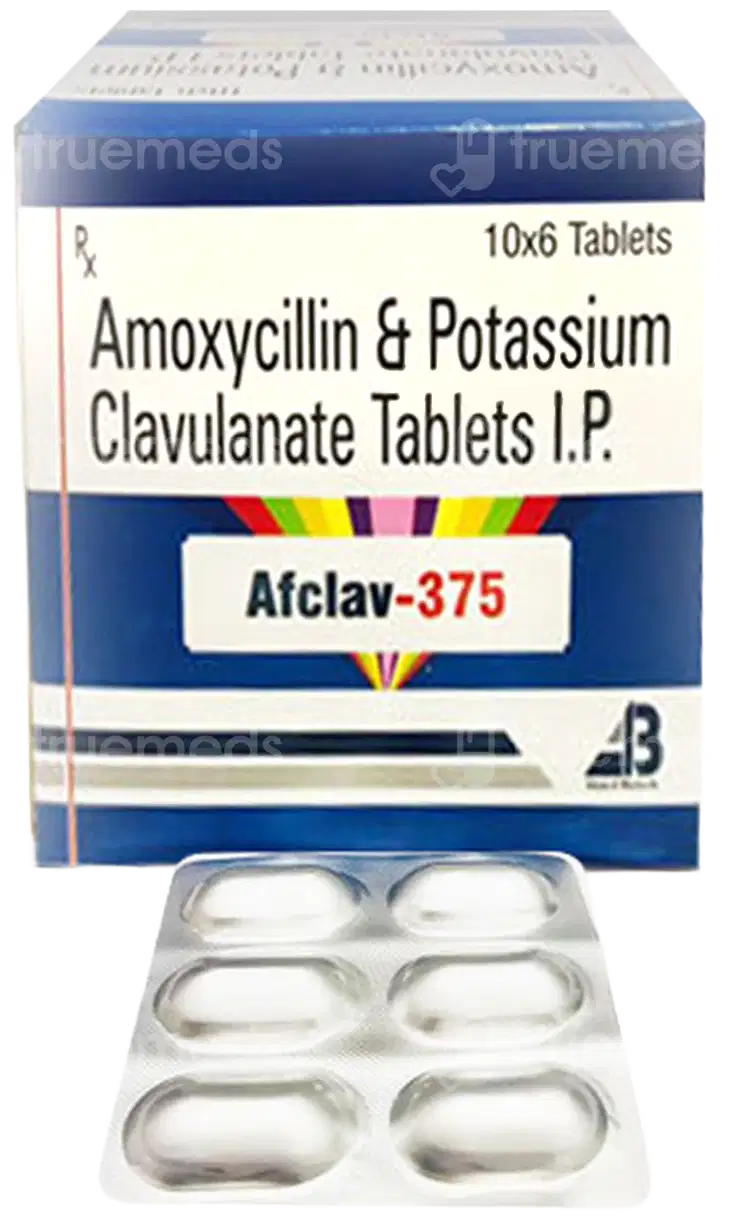
Afclav 375 MG Tablet 6
₹97.88
Quick fact
Afclav 375 is an antibiotic tablet containing amoxycillin and clavulanic acid. It is used for certain bacterial infections, including infections of the lungs, ears, sinuses, urinary tract and skin.
Uses
What is Afclav 375 MG Tablet 6 & Important Details
Afclav 375 is an antibiotic for bacterial infections. Use it only when a doctor prescribes it, and follow the prescribed dose and duration.
- It is a tablet supplied in a pack of 6 tablets.
- Its active ingredients are amoxycillin and clavulanic acid.
How does Afclav 375 MG Tablet 6 work (mechanism of action)?
The two ingredients act against bacteria in complementary ways, helping amoxycillin work against susceptible bacteria.
- Amoxycillin prevents bacteria from forming a protective covering needed for their survival.
- Clavulanic acid inhibits beta-lactamase, reducing bacterial resistance and enhancing amoxycillin’s activity.
Specialized or Off-Label Uses of Afclav 375 MG Tablet 6
No off-label uses are established in the available information.
Conditions That Afclav 375 MG Tablet 6 Will Not Treat
Afclav 375 does not treat viral infections. Antibiotics do not work against the common cold.
- Do not take it for a cold unless a doctor identifies a bacterial infection and prescribes treatment.
Benefits
What are the benefits of taking Afclav 375 MG Tablet 6
When prescribed for a susceptible bacterial infection, Afclav 375 can help clear the infection and relieve symptoms.
- It is listed for infections affecting several body areas, including the lungs, ear, sinuses, urinary tract and skin.
- The page also lists pneumonia, bronchitis, sinusitis, middle-ear infection, cellulitis, bone and joint infection, and dental abscess.
Side Effects
What are the most common side effects of Afclav 375 MG Tablet 6?
The page identifies nausea, vomiting, diarrhea and recurrent or persistent fungal infection as the most common side effects.
- Nausea, vomiting and diarrhea.
- Recurrent or persistent fungal infection, including mucocutaneous candidiasis.
What are the serious side effects of Afclav 375 MG Tablet 6?
Get medical advice promptly if diarrhea becomes severe or persistent, or if you have bloody stools or abdominal cramps.
- Severe or persistent diarrhea.
- Bloody stools or abdominal cramps.
- A rash, itching, swelling or breathing difficulty may signal a serious allergic reaction and needs urgent attention.
Contact a doctor for the warning symptoms above. Seek urgent medical attention for signs of a serious allergy.
Severe Allergic Reactions of Afclav 375 MG Tablet 6?
Stop taking Afclav 375 and seek urgent medical attention if you develop signs of a severe allergic reaction.
- Rash or itching.
- Swelling of the face or throat.
- Difficulty breathing.
These symptoms require urgent medical care. Do not take another dose while seeking help.
What side effects may I notice from receiving this medication?
Side effects that have been listed include:
- Nausea, vomiting, diarrhea and abdominal pain.
- Vaginal inflammation, rash, hives, dizziness and headache.
Speak to a doctor if side effects persist or concern you.
Afclav 375 MG Tablet 6 Dosage Guidelines
Overview
A standard adult dose for this immediate-release tablet is 1 tablet every 8 hours. The doctor decides the final dose and duration.
Adults
The usual adult dose is one tablet three times a day, up to three tablets daily. The doctor may change it.
Children
This fixed-strength tablet is generally not recommended for children unless a doctor advises it. A doctor must decide the dose.
Older adults
Ask your doctor or pharmacist to choose an appropriate dose and use the lowest effective dose. The doctor decides.
- The dose depends on the infection and its severity, as well as body weight.
- A doctor must select the dose for the person and the condition being treated.
Dosage Adjustments for Kidney, Liver, or Other Health Problems
Kidney or liver problems can affect whether this medicine is suitable and how it should be used. A clinician should review your health history.
- Normal kidney function: Use the prescribed dose; a specific adjustment is not established in the available information.
- Reduced kidney function: The dose may need adjustment. Tell your doctor about kidney disease before taking it.
- Severe kidney impairment: An exact adjustment is not established here. Get individual advice from your doctor before use.
- Dialysis: A dialysis-specific dose is not established in the available information. Ask your doctor to determine the dose.
- Liver disease: Tell your doctor before taking Afclav 375 if you have liver disease.
- Other important conditions: Tell your doctor about allergies to antibiotics and all other medicines you take.
Do not adjust the dose yourself; ask your doctor or pharmacist for advice specific to you.
How Often and How Long to Take Afclav 375 MG Tablet 6?
Take Afclav 375 at the intervals and for the duration prescribed. The available information does not establish a usual course length.
- Taking it at the same time daily may help you remember.
- Complete the prescribed course, even if you feel better.
How should I take Afclav 375 MG Tablet 6?
Taking Afclav 375 MG Tablet 6 With or Without Food
Take Afclav 375 with or after food. Taking it with a meal is recommended to reduce the chance of stomach upset.
How to Take Specific Forms (Tablets, Chewables, Liquid Suspension)
Tablets: Swallow the tablet whole. Do not chew, crush or break it.
Overdose/Missed Dose
What should I do if I accidentally use too much Afclav 375 MG Tablet 6?
What to do after taking too much is not established in the available information. Contact a doctor or pharmacist promptly for advice.
What should I do if I miss a dose of Afclav 375 MG Tablet 6?
Missed-dose instructions are not established in the available information. Ask your doctor or pharmacist what to do; do not take extra medicine without their advice.
Interactions
Does Afclav 375 MG Tablet 6 interact with foods or drinks?
Taking Afclav 375 with a meal may reduce the chance of stomach upset. The page also advises simple meals and avoiding fatty or spicy food.
Does Afclav 375 MG Tablet 6 interact with other medicines (drug interactions)
Other medicines may affect or be affected by Afclav 375. Tell your doctor about all medicines you take before starting it.
- No specific interacting medicines or medicine classes are identified in the available information.
Afclav 375 MG Tablet 6 and Blood Thinners
A specific interaction with blood thinners is not established in the available information. Tell your doctor about all medicines you take.
Afclav 375 MG Tablet 6 and Birth Control (if applicable)
A specific interaction with birth control is not established in the available information. Ask a doctor or pharmacist if you have concerns.
Interactions with Supplements, Vitamins, and Herbal Products
Specific interactions with supplements, vitamins or herbal products are not established in the available information. Tell your doctor about anything you take.
Warnings & Precautions
Who should not use Afclav 375 MG Tablet 6?
The available information does not identify who must never use Afclav 375. Some health conditions or allergies may require medical advice before use.
- Tell your doctor if you are allergic to any antibiotics.
- Tell your doctor if you have kidney or liver problems.
What should I know about Afclav 375 MG Tablet 6 before using it?
Use Afclav 375 only as advised by a doctor, and share relevant health and medicine information before treatment.
- Tell your doctor about antibiotic allergies and kidney or liver problems.
- Tell your doctor about all other medicines you take.
Precautions for Pre-existing Conditions (Heart, Kidney, Liver)
Kidney disease: Tell your doctor before taking Afclav 375; an individual dose adjustment may be needed.
Liver disease: Tell your doctor before taking Afclav 375.
Heart disease: A specific precaution for heart disease is not established in the available information.
Alcohol: Can You Drink Alcohol While Taking Afclav 375 MG Tablet 6?
Alcohol-specific advice is not established in the available information. Ask your doctor or pharmacist if you are unsure.
Pregnancy and Breastfeeding
Pregnancy: Consult your doctor before taking Afclav 375 to check whether it is safe for you.
Breastfeeding: Consult your doctor before taking Afclav 375 to check whether it is safe for you.
Children: This fixed-strength tablet is generally not recommended for children unless a doctor advises it.
Older adults: Ask your doctor to decide the appropriate dose for you.
Safe Usage & Best Practices
Why You Must Complete the Full Prescription
Complete the full course prescribed. Stopping early may allow bacteria to survive and the infection to return or worsen.
Consequences of Skipping Doses or Sharing Medication
Take the medicine as prescribed and do not use leftover tablets for a future infection.
- Do not stop the course early, even if you feel better.
- Do not share your medicine; ask a doctor before using an antibiotic.
Can Afclav 375 MG Tablet 6 cause diarrhea?
Yes. Diarrhea is listed among the most common side effects of Afclav 375.
- Nausea and vomiting are also listed among the most common side effects.
- Seek medical advice if diarrhea is severe or persistent, or if you notice bloody stools or abdominal cramps.
What should you do if you feel better before finishing the medication?
Keep taking Afclav 375 for the full prescribed course, even if you feel better. Stopping early may let the infection return or worsen.
- Follow the duration advised by your doctor.
- Ask your doctor if you are considering stopping treatment.
Storage Details
Storage conditions are not established in the available information. Check the pack instructions or ask a pharmacist how to store it.
Frequently asked questions
-
1. What is Afclav 375 used for?
Ans: It is used for certain bacterial infections, including infections of the lungs, ear, sinuses, urinary tract, skin and soft tissue.
-
2. Can it treat a common cold?
Ans: No. It does not work for viral infections such as the common cold.
-
3. Should I take it with food?
Ans: Yes. Take it with or after food to reduce the chance of stomach upset.
-
4. What if I feel better before finishing it?
Ans: Complete the full prescribed course; stopping early may make the infection return or worsen.
-
5. What should I do if I get a rash or breathing difficulty?
Ans: Stop taking it and seek urgent medical attention.