
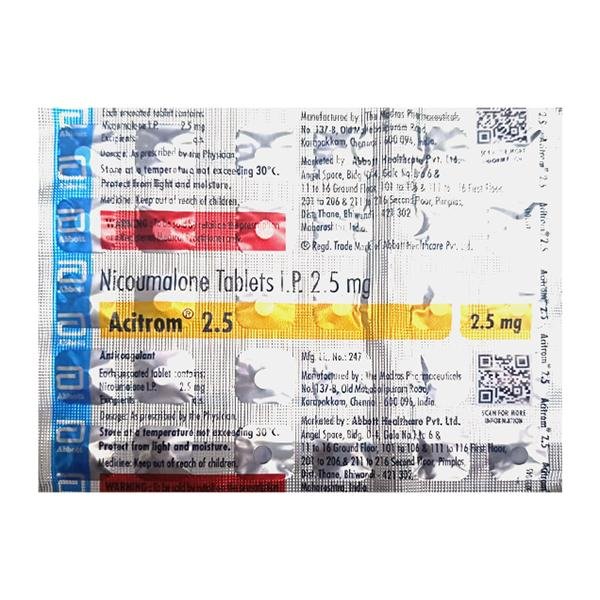
Acitrom 2.5 Tablet 30
₹559.25
Quick fact
Acitrom is an oral anticoagulant containing acenocoumarol. It is used to prevent or treat deep vein thrombosis and pulmonary embolism, and to help prevent stroke.
Uses
What is Acitrom 2.5 Tablet 30 & Important Details
Acitrom is a prescription oral anticoagulant used to prevent or treat certain blood clots. Your doctor will decide whether it is suitable for you and monitor your treatment.
- It is supplied as a tablet in a pack of 30 tablets.
- The active ingredient is acenocoumarol.
How does Acitrom 2.5 Tablet 30 work (mechanism of action)?
Acenocoumarol slows the body’s ability to form blood clots by blocking vitamin K, which is needed to make clotting proteins in the liver.
- It blocks the action of vitamin K.
- This reduces the clotting proteins made in the liver.
Specialized or Off-Label Uses of Acitrom 2.5 Tablet 30
The available information does not establish any specialized or off-label uses for Acitrom. Use it only for a condition your doctor has advised it for, and ask your doctor or pharmacist if you are unsure.
Conditions That Acitrom 2.5 Tablet 30 Will Not Treat
The available information does not specify conditions that Acitrom will not treat. It is used for certain blood clots and stroke prevention, but this does not mean it treats every clot-related condition. Ask your doctor whether it is appropriate for your condition.
Benefits
What are the benefits of taking Acitrom 2.5 Tablet 30
Acitrom reduces the body’s ability to form blood clots. Its stated uses include preventing or treating certain clot-related conditions.
- It helps prevent and treat deep vein thrombosis by reducing the risk of harmful clots forming in deep veins.
- It is used for pulmonary embolism and stroke prevention.
Side Effects
What are the most common side effects of Acitrom 2.5 Tablet 30?
Bleeding is described as the most common side effect. Other listed common side effects are:
- Dizziness
- Headache
- Weakness
- Blurred vision
Contact your doctor if side effects persist or concern you.
What are the serious side effects of Acitrom 2.5 Tablet 30?
Bleeding needs particular attention while taking Acitrom. Tell your doctor immediately if you notice any of these warning signs:
- A pinpoint rash
- Blood in vomit, urine, or stool
Contact a doctor immediately if these symptoms occur. If you are worried about severe or ongoing bleeding, seek urgent medical help.
Severe Allergic Reactions of Acitrom 2.5 Tablet 30?
The supplied information does not describe specific allergic reaction symptoms for this medicine.
- If you think you are having a severe allergic reaction, seek emergency medical care.
Do not wait for symptoms to worsen before getting emergency help.
What side effects may I notice from receiving this medication?
Bleeding is the most common side effect described for Acitrom.
- Dizziness
- Headache
- Weakness
Tell your doctor if a side effect persists or worries you.
Acitrom 2.5 Tablet 30 Dosage Guidelines
Overview
Acenocoumarol is generally taken once daily, with the amount adjusted according to blood-test results and the reason for treatment. Your doctor decides the final dose.
Adults
Acitrom is taken once daily, but the usual adult amount and maximum daily dose are not established in the available information. Your doctor will set the dose using blood-test results and may change it.
Children
There is no standard child dose for general use; children should take it only under specialist medical advice. A doctor must decide.
Older adults
Older adults may need a lower starting dose and careful adjustment; use the lowest effective dose. The doctor decides.
- The dose depends on blood-test results and individual response.
- Kidney or liver disease and other medicines may affect the treatment plan; tell your doctor about them.
Dosage Adjustments for Kidney, Liver, or Other Health Problems
Acenocoumarol doses are individualized and adjusted with medical monitoring. Tell your doctor about health conditions and other medicines.
- Normal kidney function: Dose is individualized and adjusted using blood-test results.
- Reduced kidney function: No specific adjustment is established here; tell your doctor about kidney disease.
- Severe kidney impairment: No specific dose adjustment is established in the available information; your doctor must assess your treatment.
- Dialysis: A dialysis-specific dose is not established in the available information. Ask your treating doctor to guide dosing.
- Liver disease: Tell your doctor before use if you have liver disease; a specific adjustment is not stated here.
- Other important conditions: Tell your doctor about other medicines, supplements, and herbal products before treatment.
Do not adjust or stop the dose yourself. Follow your doctor’s instructions and attend the blood tests arranged for you.
How Often and How Long to Take Acitrom 2.5 Tablet 30?
The usual pattern is once-daily dosing, but the duration depends on your condition and your doctor’s plan. Take it exactly as advised.
- Take it at the same time each day if your doctor has advised this routine.
- Do not stop it abruptly or change the duration without consulting your doctor.
How should I take Acitrom 2.5 Tablet 30?
Taking Acitrom 2.5 Tablet 30 With or Without Food
Acitrom may be taken with or without food. Avoid sudden major changes to your diet during treatment.
How to Take Specific Forms (Tablets, Chewables, Liquid Suspension)
Tablets: Swallow the tablet whole. Do not chew, crush, or break it.
Overdose/Missed Dose
What should I do if I accidentally use too much Acitrom 2.5 Tablet 30?
The supplied information does not state what to do after taking too much. Contact a doctor or seek urgent medical advice promptly, especially if there is bleeding.
What should I do if I miss a dose of Acitrom 2.5 Tablet 30?
Missed-dose instructions are not established in the supplied information. Ask your doctor or pharmacist what to do; do not take an extra dose unless they instruct you to.
Interactions
Does Acitrom 2.5 Tablet 30 interact with foods or drinks?
Avoid sudden major changes to your diet during treatment, and do not consume alcohol while taking Acitrom because it may increase side effects.
Does Acitrom 2.5 Tablet 30 interact with other medicines (drug interactions)
The supplied information does not list specific interacting medicines. Tell your doctor about every medicine you take before starting Acitrom.
- Mention prescription and non-prescription medicines, supplements, and herbal products.
Acitrom 2.5 Tablet 30 and Blood Thinners
A specific interaction with other blood thinners is not established in the supplied information. Ask your doctor before combining medicines.
Acitrom 2.5 Tablet 30 and Birth Control (if applicable)
A specific interaction with birth control is not established in the supplied information. Ask your doctor or pharmacist about your medicines.
Interactions with Supplements, Vitamins, and Herbal Products
Tell your doctor if you take supplements or herbal products before using Acitrom. Specific interactions are not listed in the available information.
Warnings & Precautions
Who should not use Acitrom 2.5 Tablet 30?
The supplied information does not list specific conditions in which Acitrom must never be used. Discuss your health and medicines with your doctor before treatment.
- Tell your doctor if you have kidney or liver disease.
- Tell your doctor about medicines, supplements, and herbal products you use.
- Tell your doctor if you are pregnant or breastfeeding.
What should I know about Acitrom 2.5 Tablet 30 before using it?
Acitrom increases bleeding risk, so take it only as directed and keep in contact with your doctor during treatment.
- Use care when shaving, handling sharp objects, or cutting your nails, and be cautious with contact sports.
- Tell your doctor about kidney or liver disease and all medicines, supplements, or herbal products.
- Tell your doctor before surgery or dental treatment; do not stop the medicine on your own.
Precautions for Pre-existing Conditions (Heart, Kidney, Liver)
Kidney disease: Tell your doctor before use if you have kidney disease.
Liver disease: Tell your doctor before use if you have liver disease.
Heart disease: A specific precaution for pre-existing heart disease is not established in the supplied information. Discuss your condition with your doctor.
Alcohol: Can You Drink Alcohol While Taking Acitrom 2.5 Tablet 30?
Do not consume alcohol while taking Acitrom; it may increase side effects.
Pregnancy and Breastfeeding
Pregnancy: Tell your doctor if you are pregnant before taking Acitrom.
Breastfeeding: Tell your doctor if you are breastfeeding before taking Acitrom.
Children: A standard child dose is not established here; use only on specialist medical advice.
Older adults: The dose should be individually assessed by the doctor.
Safe Usage & Best Practices
Why You Must Complete the Full Prescription
Take Acitrom for the duration prescribed. Do not stop it abruptly without consulting your doctor.
Consequences of Skipping Doses or Sharing Medication
Missed-dose and sharing advice is not detailed in the supplied information. Ask your doctor or pharmacist for guidance rather than changing treatment yourself.
- Do not stop Acitrom without consulting your doctor.
- Do not share prescription medicines with another person.
Can Acitrom 2.5 Tablet 30 cause bleeding?
Yes. Bleeding is described as the most common side effect of Acitrom.
- Tell your doctor immediately about a pinpoint rash or blood in vomit, urine, or stool.
What should you do if you feel better before finishing the medication?
Feeling better does not mean you should stop Acitrom. Do not stop it abruptly without talking to your doctor.
- Continue as prescribed and attend blood tests arranged by your doctor.
Storage Details
Storage instructions are not established in the supplied information. Ask a pharmacist how to store this medicine safely.
Frequently asked questions
-
1. What is Acitrom used for?
Ans: It is used for deep vein thrombosis, pulmonary embolism, blood clots, and stroke prevention.
-
2. Can I take it with food?
Ans: It may be taken with or without food.
-
3. What is its most common side effect?
Ans: Bleeding is described as the most common side effect.
-
4. Should I stop before surgery or dental treatment?
Ans: Discuss this with your doctor; do not stop the medicine without consulting them.
-
5. Do I need blood tests while taking it?
Ans: Your doctor may arrange regular blood tests to check that the medicine is working properly.

