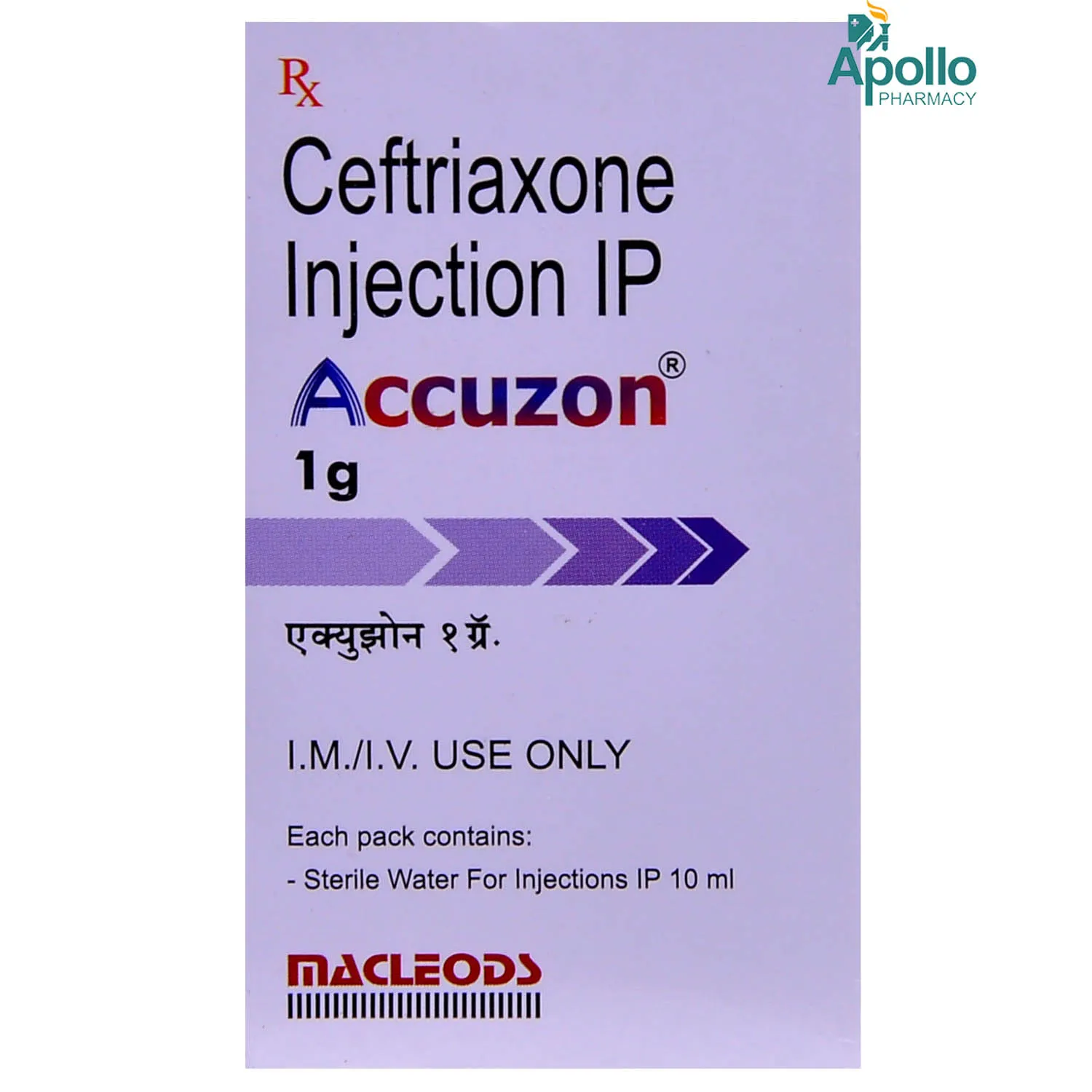
Accuzon 1g Injection 1
₹65.49
Quick fact
Accuzon 1g Injection is a ceftriaxone antibiotic given by a healthcare professional to treat bacterial infections, including infections affecting several parts of the body.
Uses
What is Accuzon 1g Injection 1 & Important Details
Accuzon 1g Injection is a prescription antibiotic for bacterial infections. A doctor or nurse administers it; it is not for self-injection.
- It is a powder for injection supplied as one injection.
- Its active ingredient is ceftriaxone.
- It is used for bacterial infections, including infections of the brain, lungs, ear, urinary tract, skin and soft tissues, bones and joints, blood, and heart.
How does Accuzon 1g Injection 1 work (mechanism of action)?
Ceftriaxone acts against bacteria by interfering with their cell-wall formation.
- Bacteria need a protective cell wall to survive.
- Ceftriaxone prevents bacteria from forming that wall.
- This damages the bacteria and can cause them to rupture.
Specialized or Off-Label Uses of Accuzon 1g Injection 1
Specific off-label uses are not established in the available information. Ask your doctor why this injection has been prescribed for you.
Conditions That Accuzon 1g Injection 1 Will Not Treat
Accuzon is used for bacterial infections. The available information does not establish other conditions it treats.
Benefits
What are the benefits of taking Accuzon 1g Injection 1
Accuzon treats bacterial infections when a doctor considers ceftriaxone suitable.
- It may be used for infections affecting the brain, lungs, ear, urinary tract, skin and soft tissues, bones and joints, blood, or heart.
- It may also be used to prevent infection during surgery.
Side Effects
What are the most common side effects of Accuzon 1g Injection 1?
The listed common side effects include digestive symptoms, skin changes, and changes where the injection is given.
- Diarrhoea.
- Nausea or vomiting.
- Rash.
- Pain, swelling, or redness at the injection site.
Tell your doctor if a side effect persists, bothers you, or becomes serious.
What are the serious side effects of Accuzon 1g Injection 1?
Some symptoms need prompt medical attention. Contact your doctor immediately if you develop any of the following.
- Severe watery diarrhoea.
- A widespread skin rash.
- Yellowing of the skin or eyes.
Seek medical advice promptly rather than waiting to see whether these symptoms settle.
Severe Allergic Reactions of Accuzon 1g Injection 1?
A serious allergic reaction may require emergency care. Stop Accuzon and inform a doctor immediately if you notice these symptoms.
- Rash or itchy skin.
- Swelling of the face or mouth.
- Difficulty breathing.
Get emergency medical help for difficulty breathing or swelling of the face or mouth.
What side effects may I notice from receiving this medication?
You may notice digestive symptoms or a reaction where the injection was given.
- Diarrhoea, nausea, or vomiting.
- Pain, swelling, or redness at the injection site.
- Rash.
Tell your doctor if symptoms do not improve or become serious.
Accuzon 1g Injection 1 Dosage Guidelines
Overview
A usual ceftriaxone dose for adults is 1–2 g once daily; the dose and schedule depend on the infection. Your doctor decides the final dose and gives the injection at evenly spaced intervals as prescribed.
Adults
A usual adult dose is 1–2 g once daily, with a usual maximum of 4 g per day. The doctor may change it.
Children
Accuzon may be prescribed for children; the dose depends on age, weight and infection severity. A doctor must decide the final dose.
Older adults
Older adults generally use the usual adult dose, with caution and clinical monitoring. The doctor decides.
- The infection being treated and its severity can affect the prescribed dose.
- Age and body weight are considered when deciding a dose.
- Your doctor should know about kidney or liver problems.
Dosage Adjustments for Kidney, Liver, or Other Health Problems
Dose changes depend on kidney and liver function and other health factors. Your clinician should choose the dose.
- Normal kidney function: No special adjustment is generally needed.
- Reduced kidney function: An isolated reduction in kidney function usually does not require adjustment; the doctor should assess your situation.
- Severe kidney impairment: If severe kidney impairment occurs together with significant liver impairment, the daily dose is generally limited to 2 g.
- Dialysis: A supplemental dose after dialysis is generally not required; the doctor should monitor and decide.
- Liver disease: Tell your doctor; dose adjustment may be needed, particularly if kidney function is also impaired.
- Other important conditions: Tell your doctor about other conditions and all medicines you use before treatment.
Do not decide or change your dose yourself; ask your doctor or pharmacist if you have concerns.
How Often and How Long to Take Accuzon 1g Injection 1?
Your doctor sets how often and how long you receive Accuzon according to your infection and prescribed schedule.
- Receive doses at the intervals set by your doctor.
- Complete the full course, even if you feel better.
- Follow your doctor’s instructions about the duration.
How should I take Accuzon 1g Injection 1?
Taking Accuzon 1g Injection 1 With or Without Food
Specific food instructions for Accuzon are not established in the available information. Ask your doctor or pharmacist if you have questions about meals during treatment.
How to Take Specific Forms (Tablets, Chewables, Liquid Suspension)
Powder for injection: A doctor or nurse prepares and gives this medicine by infusion into a vein or injection into a vein or muscle. Do not self-administer it.
Overdose/Missed Dose
What should I do if I accidentally use too much Accuzon 1g Injection 1?
If an overdose is suspected, or severe symptoms such as muscle twitches or seizures occur, seek immediate emergency medical attention.
What should I do if I miss a dose of Accuzon 1g Injection 1?
If a dose is missed, contact your doctor or home-care provider promptly for instructions. Do not double the next dose.
Interactions
Does Accuzon 1g Injection 1 interact with foods or drinks?
Avoid alcohol during treatment. Specific interactions with foods are not established in the available information.
Does Accuzon 1g Injection 1 interact with other medicines (drug interactions)
Tell your doctor about all medicines you use. Accuzon should not be mixed with calcium-containing fluids in the same intravenous line.
- Blood thinners such as warfarin may increase bleeding risk when used with this injection.
- Do not mix it with calcium-containing fluids in the same intravenous line.
Accuzon 1g Injection 1 and Blood Thinners
Blood thinners such as warfarin may increase bleeding risk with Accuzon. Your doctor may monitor blood-clotting measures.
Accuzon 1g Injection 1 and Birth Control (if applicable)
Information about an interaction with birth control is not established. Ask your doctor or pharmacist for advice.
Interactions with Supplements, Vitamins, and Herbal Products
Specific interactions with supplements, vitamins, or herbal products are not established in the available information. Tell your doctor about everything you take.
Warnings & Precautions
Who should not use Accuzon 1g Injection 1?
Tell your doctor before receiving Accuzon if you have had an allergy to antibiotics or problems affecting your kidneys or liver.
- Do not receive it if you have a known severe allergy to cephalosporin antibiotics.
- It is not recommended for a premature baby or a newborn baby with jaundice.
What should I know about Accuzon 1g Injection 1 before using it?
Before treatment, tell the doctor about your medical history, allergies, and medicines.
- Mention any kidney or liver problems, gallbladder issues, or allergies to antibiotics.
- Do not mix the injection with calcium-containing fluids in the same intravenous line.
- A doctor or nurse must administer the injection.
Precautions for Pre-existing Conditions (Heart, Kidney, Liver)
Kidney disease: Tell your doctor; dose adjustment may be needed.
Liver disease: Tell your doctor; dose adjustment may be needed.
Heart disease: Consult your doctor before receiving Accuzon if you have pre-existing heart problems.
Alcohol: Can You Drink Alcohol While Taking Accuzon 1g Injection 1?
Avoid alcohol during Accuzon treatment.
Pregnancy and Breastfeeding
Pregnancy: Consult your doctor. The injection will be prescribed only if the benefits outweigh the risks.
Breastfeeding: Consult your doctor. The injection will be prescribed only if the benefits outweigh the risks.
Children: A doctor should decide whether it is suitable. It is not recommended for premature babies or newborns with jaundice.
Older adults: Use under medical supervision and consult a doctor before receiving it.
Safe Usage & Best Practices
Why You Must Complete the Full Prescription
Complete the full course as prescribed, even if you feel better, to reduce the risk of the infection returning or worsening.
Consequences of Skipping Doses or Sharing Medication
Do not skip doses or stop treatment early without your doctor’s advice.
- Skipping doses may make it harder to complete the prescribed course.
- Stopping too early may allow the infection to return or worsen.
- This prescription is for the person it was prescribed for; ask a doctor or pharmacist if you need advice.
Can Accuzon 1g Injection 1 cause diarrhoea?
Yes. Diarrhoea is listed as a common side effect of Accuzon.
- Nausea or vomiting may also occur.
- Tell your doctor if diarrhoea is severe, persists, or includes blood.
What should you do if you feel better before finishing the medication?
Keep receiving Accuzon for the full course, even if you feel better. Stopping early may allow the infection to return or worsen.
- Do not stop treatment without your doctor’s advice.
- Ask your doctor if you are concerned about side effects or your treatment.
Storage Details
Store the unmixed powder vial at room temperature and protect it from light and moisture.
- Keep the vial in its original packaging.
- Store between 20°C and 25°C (68°F and 77°F).
Frequently asked questions
-
1. What is Accuzon used for?
Ans: It is used to treat bacterial infections.
-
2. Who gives the injection?
Ans: A doctor or nurse gives it; do not self-administer.
-
3. Can it cause diarrhoea?
Ans: Yes. Diarrhoea is listed as a common side effect.
-
4. What if I miss a dose?
Ans: Contact your doctor or home-care provider for instructions; do not double the dose.
-
5. Can I drink alcohol during treatment?
Ans: Avoid alcohol while receiving Accuzon.